
Use data to make this hazardous environment safer for your team.
For utilities workers doing tasks in confined spaces, the visibility offered by continuous real-time data can be the difference between a safe entry and a serious injury or fatality (SIF) from a known hazard.
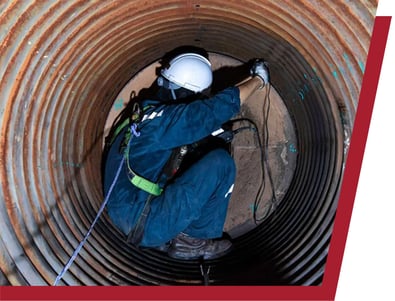
Making confined entries as safe as possible—for power, water and wastewater, and natural gas workers—means understanding what hazards might be present before entry, monitoring workers and their data during the entry, and reviewing the work after to improve processes in the future. Tapping into leading indicators before confined space entries occur is one way to lower the risks associated with this hazardous environment.
“One of the most underutilized aspects of safety is data analysis.”
– Risk and Safety Director, Construction and Transportation
Confined Space, Broad Risks

Blackline Safety conducted a third-party survey of 200 safety and operations leaders from around the world for a report about the state of workplace safety. Here’s what we learned about the role data plays in creating a more informed safety program.
While 73% of safety leaders surveyed look at individual incident reports and near-miss records, only 33.5% spend their time on predictive analytics. Using data to forecast risk by surfacing leading indicators turns your data from a reactive tool to a proactive one, and when lagging indicators become leading indicators, we can prevent incidents before they happen.
Making sure workers are prepared for confined space entries means reading the leading indicators found in the existing data. Focusing on the following areas can help build confidence in your team and reduce the chance of SIFs on your worksite.
Leading Indicators
Pre-Entry Gas Readings
A pre-entry check with a connected wearable multi-gas detector can reveal the presence of toxic gases, oxygen deficiency, or a potentially explosive atmosphere. This helps identify hazardous conditions before workers enter the confined space. The data can also be transmitted in real-time to remote monitoring teams for full situational awareness.
Near-Miss and Alarm Trends
Near-miss trends across entries and alarms during CSEs are the clearest indicators we have as to which elements and moments of a confined space entry are the most dangerous. Knowing where incidents have escalated in the past can help leaders plan for safer future entries—not just for workers, but for those designated to rescue them should something go wrong. According to CCOHS, an estimated 60% of Canadian confined space fatalities are rescuers. Both reading the leading indicators and being able to transmit real-time alerts during incidents can be the difference between an informed rescue team with everything they need to make a safe entry — like exact location and hazard type — and a blind rescue that leads to an escalated incident.
Controls
Real-Time Connectivity
Depending on the depth or location of the confined space, connectivity can become a critical control. Cloud connectivity, specifically, enables the relay of critical real-time information from within the confined space to workers outside, and monitoring personnel. Having layers of communication, like two-way voice or Push-To-Talk functionality, also offers confidence that workers can reach a real human should something go wrong.
Monitoring & Review
Centralized confined space monitoring (CCSM), also known as remote, digital, or real-time confined space monitoring, is recognized in some jurisdictions as being equivalent to having an attendant worker physically present. CCSM integrates real-time gas monitoring, cameras, access control, ventilation equipment, and two-way communication into a system monitored by a command center. This method ensures operators can monitor gas detection data from a safe distance which ensures they can take timely action to protect workers without being exposed to the confined space hazards themselves.
With access to the right data and reports, leaders can make continuous, evidence-based safety improvements to this hazardous practice, all while boosting performance and managing compliance. U.K. bioresource operation, Wessex Water, used data from over 170 connected Blackline Safety devices in their review process to uncover unexpected exposures which they were then able to investigate. Leveraging analytics from connected devices used in CSEs can lead to proactive safety and supports better planning and preparation, which reduces the likelihood of unexpected hazards in future entries.
“Even the best companies focus too much on the lagging indicators. 'We had an incident, someone got hurt'—well, you know what? There were probably 100 leading indicators before that event.”
– Facilities Manager, Natural Gas
La toute nouvelle G8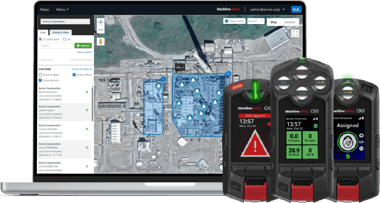
Leveraging the predictive leading indicators revealed by real-time data is one of the key strategies for making confined space entries safer and more efficient. The latest in Blackline's suite of connected safety products is the all-new G8. The rugged, intrinsically-safe device, paired with Blackline Live software, responds to frequent issues seen in confined spaces and utilities fieldwork, as well as common barriers to adoption, and was built with input from industrial customers around the world.
Le G8 prévoit :
- Un appareil qui remplace plusieurs autres, réduisant ainsi la fatigue physique et améliorant l'adoption.
- Des technologies de communication améliorées, qu'il s'agisse de communications vocales bidirectionnelles ou de messages texte, pour rester en contact avec les gens lorsque cela compte le plus.
- Advanced geofencing and GPS capabilities, so you know where your workers are at all times.
- Live transmission of field data and alerts to Blackline Live, so you respond quickly and turn your data into proactive mitigation.
Connected safety combines productivity with site safety, leading to efficiencies that help the work get done faster without sacrificing anyone’s wellbeing. G8 can transform your digital worksite with some of the following features:
Dual-band GPS/GNSS
Confined space infrastructure is a challenging environment for connectivity. G8’s dual-band GPS/GNSS capabilities provide improved accuracy to facilitate data-driven decisions. Combined with a beacon, direction location and accuracy in and out of the confined space are possible, even in the most challenging conditions.
Swappable Cartridges
G8 provides the ability to adapt devices for different situational requirements or different potential hazards, whether your team needs lone worker protection, single-gas, multi-gas, or multi-gas pump.
Configurable Alert Thresholds
Every job site has its own risk profiles, and different utilities workers have different needs. Configurable alert thresholds mean your site’s policies, your regulatory requirements, and your safety protocol are what set the standard of safety for your workers.
Safer Work in Confined Spaces
Creating a layered safety plan for confined space entries provides the controls needed for safer work during this high-hazard activity. Focusing on these technological and strategic areas offers your teams the confidence they can do the job and still get home safe.




